3D Printing Process Comparison
FDM vs. SLA vs. SLS: three different 3D printing processes for different combinations of cost, material, strength, detail, finish and geometry.
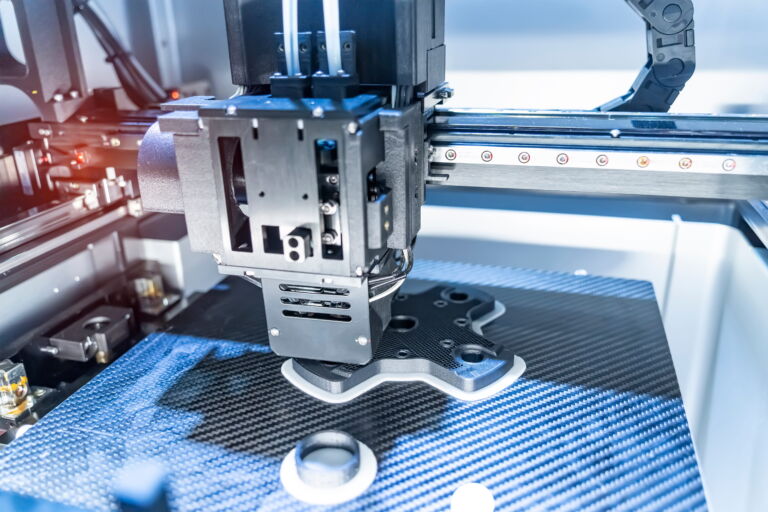
Once a component has been identified as a candidate for 3D printing, the next question is which process should make it. FDM, SLA and SLS all build parts layer by layer, but their feedstocks and energy sources are different. Those differences shape material choices, surface appearance, mechanical behaviour and cost.
Do not treat the processes as good, better and best. FDM can be the practical choice for a large bracket, SLA for a detailed presentation model and SLS for a complex nylon assembly. The right answer begins with what the part must do.
3DRM Tech offers all three through its Montreal 3D printing service, so projects can be routed according to fit rather than habit.
Short answer
Choose FDM for economical thermoplastic prototypes, fixtures and many larger functional parts. Choose SLA for fine detail and smooth resin surfaces. Choose SLS for complex, durable nylon geometry without conventional supports. Confirm the choice against material, load, finish, quantity and environment.
01FDM, SLA and SLS at a glance
FDM
Extrudes melted thermoplastic filament. Practical for functional prototypes, tooling, housings and larger parts.
SLA
Cures liquid photopolymer resin with light. Strong fit for fine detail, smooth visual surfaces and master patterns.
SLS
Fuses polymer powder with laser energy. Useful for complex nylon geometry and nested functional batches.
02FDM vs. SLA vs. SLS comparison
| Criterion | FDM | SLA | SLS |
|---|---|---|---|
| Feedstock | Thermoplastic filament | Liquid resin | Polymer powder |
| Natural finish | Visible layers | Smooth and detailed | Uniform matte texture |
| Supports | Often required | Often required | Loose powder supports parts |
| Common fit | Practical functional parts | Visual and fine-detail models | Complex nylon components |
| Batch behaviour | Print time scales by parts | Build-area and height dependent | Parts can nest in build volume |
| Key caution | Layer direction | Resin behaviour | Powder removal and cooling |
03Choose by the requirement that matters most
- Economical iteration or larger thermoplastic parts: start with FDM.
- Fine detail and smooth presentation surfaces: start with SLA.
- Complex, unsupported nylon geometry: start with SLS.
- Heat, impact or chemical exposure: compare specific material data, not only process names.
- Tight machined interfaces or metal: consider CNC instead.
04Materials and functional strength
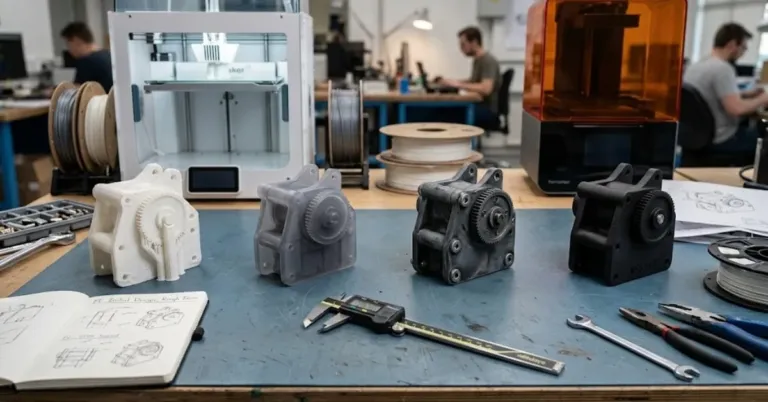
FDM offers thermoplastics such as PLA, PETG, ABS, ASA, nylon and TPU. SLA uses photopolymer resins formulated around properties such as detail, toughness, flexibility or temperature. SLS is closely associated with nylon powders such as PA12 and PA11.
There is no universal strongest process. Compare actual material, load direction, geometry, environment and test requirements. Read the material-selection guide before locking the process.
05Detail, accuracy and surface finish
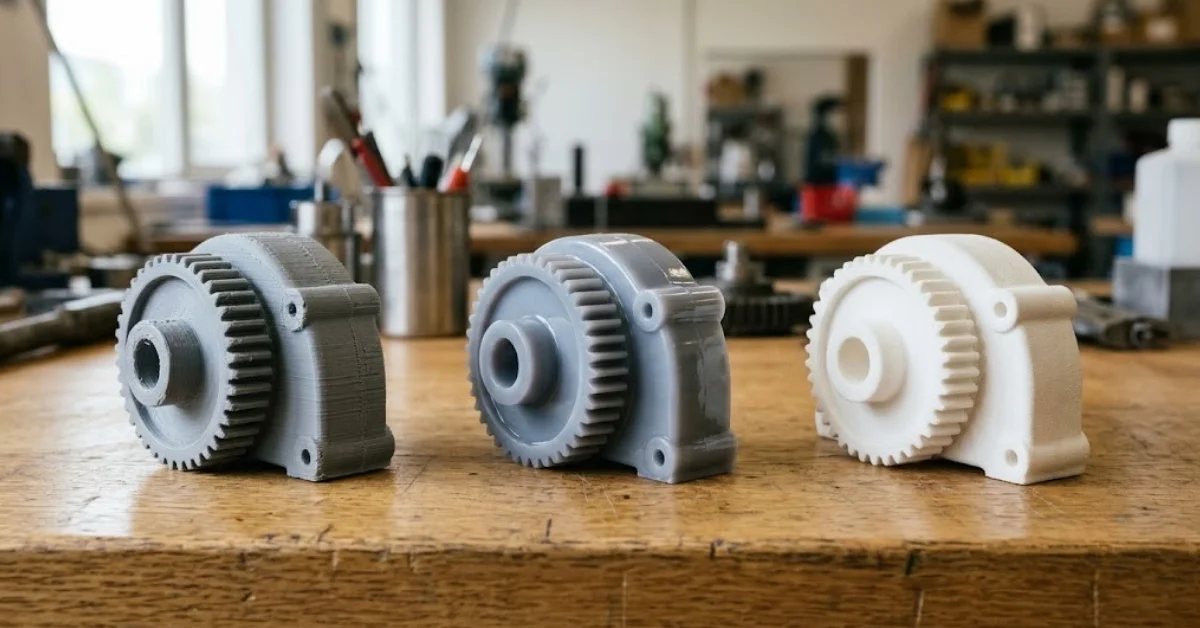
SLA generally leads when very fine visual features and a smooth surface are central. SLS produces a consistent matte texture without conventional support marks. FDM normally shows layer lines but can be effective when surface appearance is secondary to function and cost.
Accuracy depends on machine, material, size and geometry. Critical dimensions should be identified for review rather than applying one published tolerance to every feature.
06Geometry and support strategy
FDM and SLA may need removable supports for overhangs and islands. Support contact can affect accessible surfaces. SLS uses surrounding powder as support, enabling complex forms and nested components, but internal cavities need powder escape and cleaning access.
07Cost, quantity and lead time
FDM is often economical for straightforward one-offs. SLA cost reflects resin, build volume, support and finishing. SLS economics depend on material, occupied build volume, nesting, cooling and cleaning. Quantity can change the answer, especially when many SLS parts share one build.
Compare finished-part cost, including supports, cleaning, finishing, testing and rejected design iterations.
08Use different processes across development
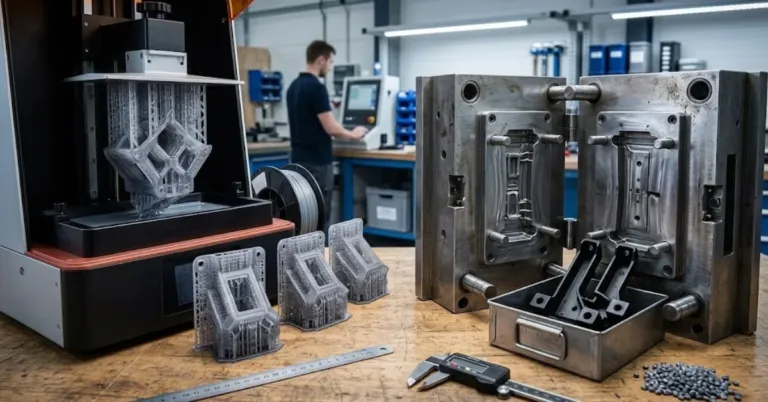
A project does not have to stay with one process. Teams may iterate in FDM, validate appearance in SLA and produce complex nylon parts in SLS. They may also machine final interfaces or transition to injection moulding when volume justifies tooling.
Rapid prototyping and low-volume production should be planned as connected stages rather than isolated orders.
09What should you send for process advice?
Send CAD, quantity, intended use, load, environment, material preferences, critical dimensions, finish and timing. If no CAD exists, CAD design support can be included.
Unsure whether to use FDM, SLA or SLS?
Send the file and functional requirements for a process and material recommendation.
Request a 3D printing review →10Frequently asked questions
// common questions, answered
What is the difference between FDM, SLA and SLS?
FDM extrudes thermoplastic filament, SLA cures liquid resin and SLS fuses polymer powder.
Which process is strongest?
Strength depends on the specific material, geometry, orientation, environment and load. SLS nylon and engineering FDM materials are common functional options.
Which has the best surface finish?
SLA generally offers the smoothest natural surface and finest visual detail.
Which process is cheapest?
FDM is often economical for straightforward one-offs, but geometry, material, size, quantity and finishing determine total cost.
Which handles complex geometry best?
SLS offers substantial freedom because surrounding powder supports the build, although trapped powder must be removable.
Does SLS need supports?
It does not normally need conventional printed supports; the loose powder supports the parts.
Is SLA only for visual models?
No. Specialized functional resins exist, but their properties must match the operating requirement.
Can FDM make end-use parts?
Yes, when material, orientation, design and testing support the application.
Can I prototype in one process and produce in another?
Yes. Switching processes between iterations and production is common.
What information determines the process?
Material, load, environment, geometry, size, critical dimensions, finish, quantity and budget.