
- Can FDM be used for production parts?
- What parts are good candidates?
- Which materials work for end-use FDM?
- How should production FDM parts be designed?
- When is FDM not the right choice?
- What quantities make sense?
- Which industries use functional FDM parts?
- What should buyers send for a quote?
- Frequently asked questions
Can FDM 3D printing be used for final production parts?
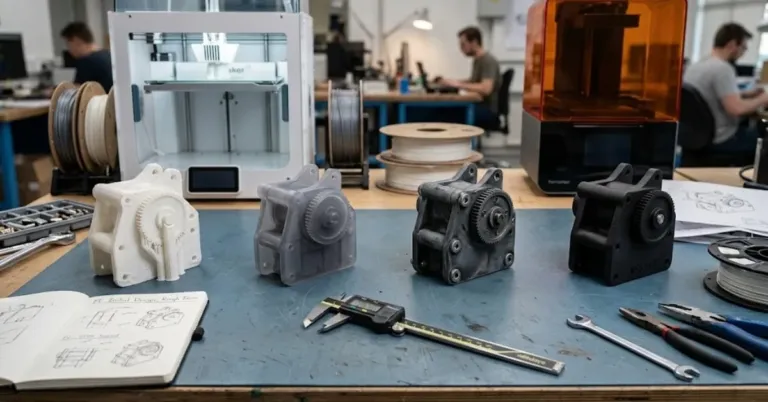
Yes. FDM is not limited to concept models or early prototypes. For suitable applications, it can produce functional parts that are used directly in equipment, products, fixtures and low-volume assemblies.
What matters is whether the part's requirements match the process. A production FDM part should be evaluated around material, loading, operating environment, geometry, print orientation, surface requirements and quantity.
3DRM Tech provides FDM 3D printing in Montreal with a focus on functional and engineering applications rather than only visual prototypes.
What kinds of production parts are good candidates for FDM?
FDM can be especially valuable when a part is likely to change between versions. Because the geometry is digital, approved CAD revisions can be incorporated into the next production run without rebuilding a mold.
Which materials are suitable for end-use FDM parts?
The material should be selected around the application rather than simply choosing the strongest-sounding filament.
| Material family | Why it may be considered | Typical questions to review |
|---|---|---|
| PETG | General functional parts, housings and fixtures | Temperature, stiffness, chemical exposure and loading |
| ABS / ASA | Functional housings, equipment parts and outdoor-capable applications depending on grade | Heat, UV exposure, dimensional requirements and environment |
| Nylon | Tough functional parts, wear applications and engineering components | Moisture, stiffness, wear, load and dimensional stability |
| Polycarbonate | Engineering parts where a higher-performance thermoplastic is appropriate | Temperature, load, geometry and processing conditions |
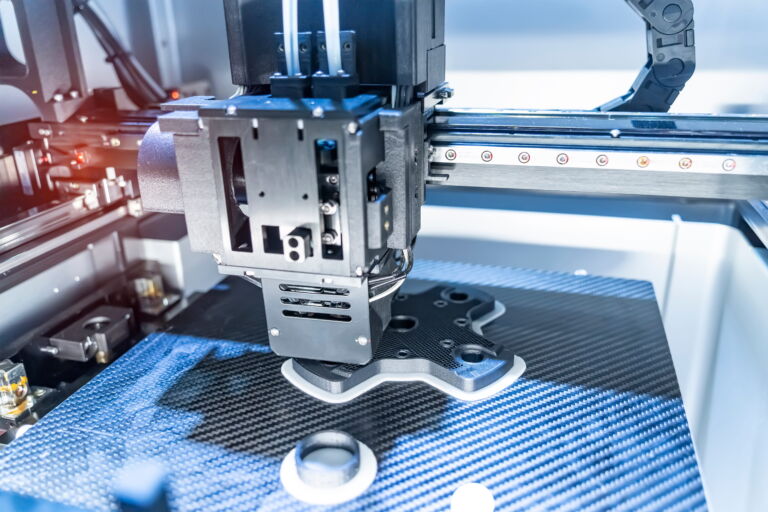
| Carbon-fiber reinforced materials | Applications where increased stiffness and reduced flex are useful | Base polymer, reinforcement system, orientation and load direction |
| Glass-fiber / aramid-reinforced systems | Specialized functional applications | Exact material system, geometry and mechanical requirements |
For a deeper comparison, see the 3D printing materials guide.
How should an FDM production part be designed?
Design around the load direction
FDM parts are built layer by layer, so orientation can influence how the finished component behaves under load. The design and print orientation should be reviewed together.
Use wall structure intentionally
Wall thickness, ribs, bosses and local reinforcement can matter more than simply increasing infill percentage.
Design interfaces carefully
Fasteners, inserts, bearings, shafts and mating surfaces should be designed around how the part will actually be assembled and used.
Avoid unnecessary complexity
Additive manufacturing handles complex geometry well, but complexity should still serve a functional purpose. Clean geometry can improve repeatability and simplify inspection.
Prototype critical features first
Where fit, assembly or load behavior is uncertain, rapid prototyping can validate the design before repeat production.
When is FDM not the right production process?
FDM is not the best choice for every part.
Another process may be more appropriate when the application requires:
- Machined metal
- Very fine cosmetic surfaces directly from the manufacturing process
- Highly specific isotropic material behavior
- Precision interfaces better suited to machining
- Production volumes where another process has clearly better economics
- Regulated or certified performance that the proposed FDM material/process cannot support
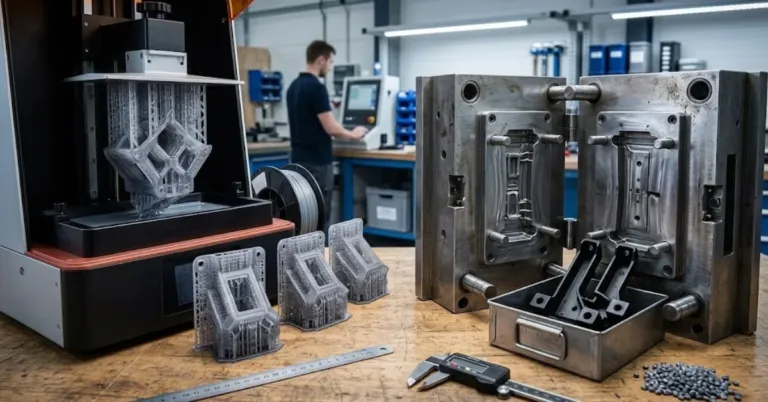
In those cases, CNC machining, SLS, SLA, composites or another manufacturing method may fit the project better.
What production quantities make sense for FDM?
There is no universal quantity limit. FDM can be practical for one custom component, a small pilot batch, recurring low-volume production or a larger set of specialized parts depending on size, material, geometry and machine time.
It is especially useful where:
- Demand is variable
- Multiple product variants exist
- Design changes are expected
- Conventional tooling would be difficult to justify
- The part is specialized rather than mass-market
For repeat requirements, see 3DRM Tech's low-volume manufacturing services.
Which industries use functional FDM production parts?
Robotics and automation
Robotics companies use custom brackets, sensor mounts, covers, interfaces, fixtures and lightweight structures that often change as the machine evolves.
Industrial manufacturing
Industrial manufacturers can use FDM for production aids, equipment components, custom housings, replacement parts and tooling.
Electronics and IoT
Electronics and IoT teams can use FDM for housings, mounting systems, test fixtures and low-volume product components.
Engineering and product development
Engineering teams can move from functional prototypes into repeat digital production without necessarily changing the manufacturing process when the final requirements continue to fit FDM.
What should I send for an FDM production quote?
- 3D CAD file if available
- Required quantity
- Material preference or operating requirements
- Expected loads
- Temperature or environmental exposure
- Critical interfaces and dimensions
- Surface or finishing requirements
- How often the part may need to be reordered
If the CAD is not finished, 3DRM Tech also provides CAD design and design-for-manufacturing support.
Frequently asked questions about FDM production parts in Montreal
Can FDM parts be used as final products?
Yes, for suitable applications. The selected material, geometry, orientation and manufacturing process must match the actual functional requirements.
What is the best FDM material for production parts?
There is no single best material. Nylon, polycarbonate, ASA, PETG and reinforced engineering materials can all be useful depending on load, environment and geometry.
Is carbon-fiber FDM good for functional parts?
Carbon-fiber-reinforced materials can be useful where increased stiffness is needed, but performance depends on the base polymer, reinforcement method, orientation and part design.
Can FDM replace CNC machining?
Sometimes, but not universally. FDM can replace machining for certain polymer parts, while CNC remains preferable for many metal components, precision interfaces and other requirements.
Can I order repeat batches of FDM parts?
Yes. Once a design and manufacturing approach are validated, suitable FDM parts can be produced in repeat batches.
Where can I get functional FDM production parts made in Montreal?
3DRM Tech is based in Mount Royal, Quebec and provides functional FDM manufacturing, SLS, SLA, CAD, CNC machining, composites and low-volume production for suitable projects.
Need a functional FDM part for real use?
Send the CAD and describe what the part needs to do, where it operates and how many you need. 3DRM Tech can review material, geometry and manufacturing options.
Request an FDM Production Review →