3D Scanning · Reverse Engineering · Guide
Rétro-ingénierie par numérisation 3D : comment recréer une pièce sans plans
3d scanning reverse engineering = capture a real part → build an accurate CAD model → remanufacture or improve it — no original drawings needed.
A part breaks. The machine it belongs to is fifteen years old, the manufacturer is gone, and there isn't a drawing anywhere. That's the situation Numérisation 3D reverse engineering exists to solve — turning a physical object you can hold into a digital model you can measure, modify, and manufacture again.
This guide covers how that actually happens: what reverse engineering means, how a 3D scan becomes a usable CAD file, which parts are good candidates, and the accuracy you can expect. For the broader background on the topic, see our complete guide. And if you already have the part in hand, you can request a quote — but here's how the process works.
Réponse courte
3d scanning reverse engineering is the process of capturing an existing physical part with a 3D scanner, converting that scan into an accurate CAD model, and using it to reproduce or redesign the part — without any original drawings. It's how obsolete components, worn tooling, and one-off parts get remanufactured when no documentation exists.
Sur cette page
01What 3d scanning reverse engineering means
Ingénierie inverse La rétro-ingénierie consiste à travailler à rebours : partir d’un objet fini et reconstituer sa conception. L’ingénierie classique (« directe ») suit le schéma conception → dessin → pièce. La rétro-ingénierie, quant à elle, suit le schéma pièce → mesure → modèle. On obtient ainsi le fichier CAO correspondant à la pièce d’origine.
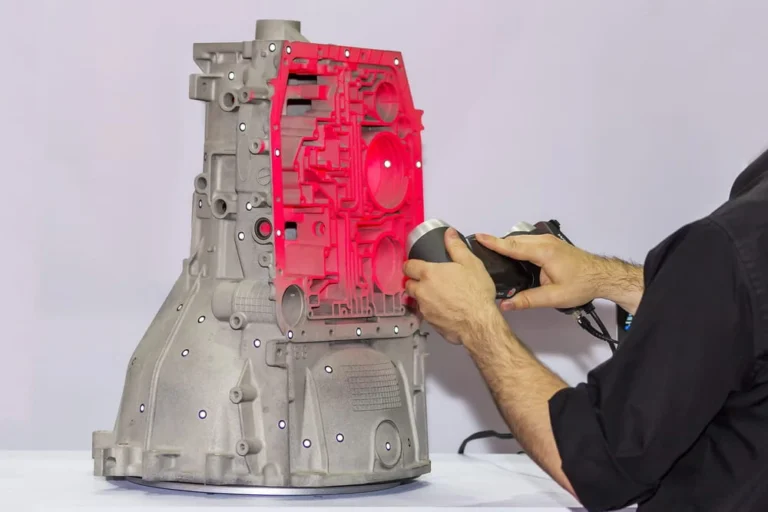
La partie « numérisation 3D » consiste à capturer la géométrie. Au lieu de mesurer manuellement une forme complexe avec un pied à coulisse — une méthode lente et inefficace sur les surfaces courbes ou organiques —, un scanner 3D enregistre simultanément la surface entière sous forme de millions de points. Ces données ponctuelles constituent la base du modèle CAO. 3d scanning reverse engineering est la méthode rapide et précise pour numériser une pièce réelle afin qu'elle puisse être reproduite ou améliorée.
02How 3d scanning reverse engineering works
Le processus de rétro-ingénierie par numérisation 3D se déroule en quatre étapes, de la pièce physique au fichier exploitable pour la fabrication. Pour découvrir l'ensemble du processus à travers un projet concret, nous vous expliquons comment transformer une numérisation en un fichier exploitable pour la fabrication. pièce finie dans un autre message.
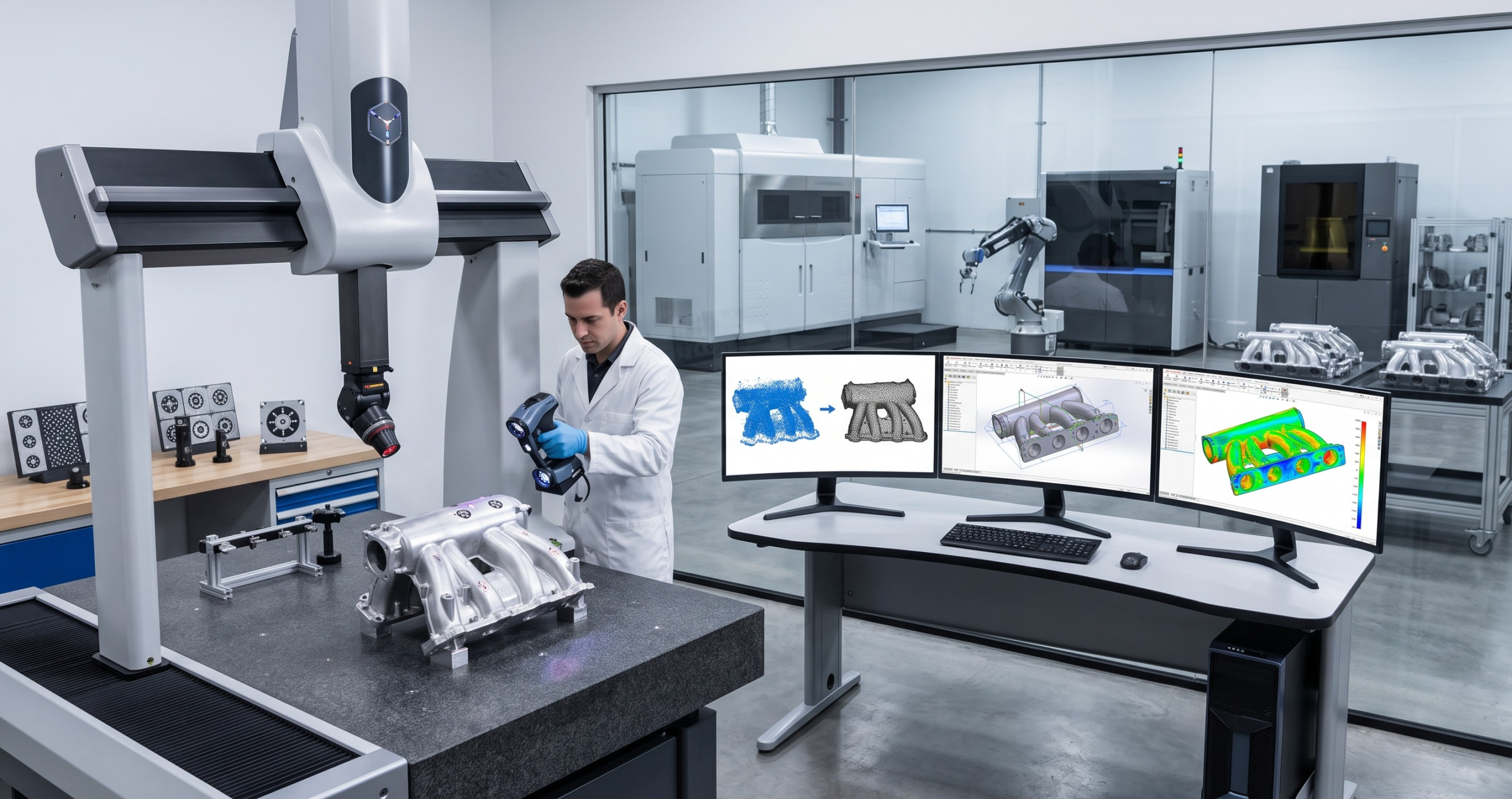
The 3d scanning reverse engineering workflow
Scan la partie→ engrener Les données brutes sur une surface propre → reconstruire le tout en mode éditable GOUJAT → fabrication la nouvelle partie.
Scanner la pièce
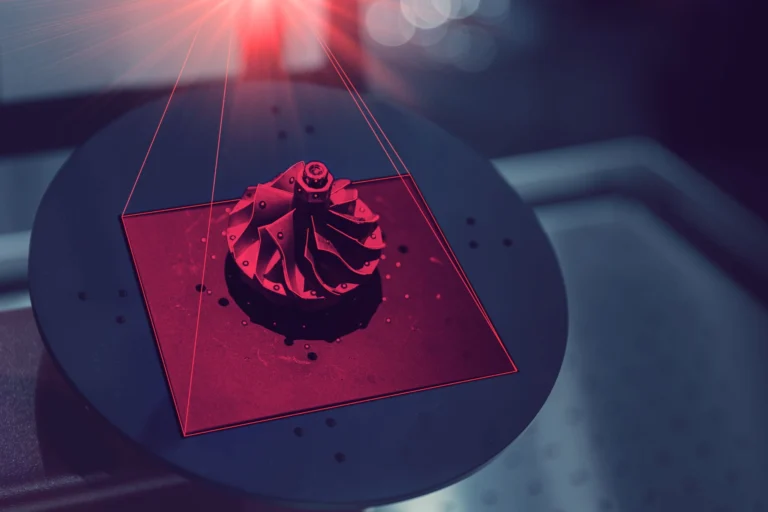
La pièce est numérisée à l'aide d'un scanner à lumière structurée ou laser, produisant un nuage de points dense : une carte 3D de chaque surface. Les petites pièces détaillées bénéficient de numérisations haute résolution ; les grands assemblages peuvent être numérisés par sections puis assemblés.
Maillage et nettoyage
Raw scan data is messy — gaps where the scanner couldn't reach, noise, overlapping passes. This stage cleans it into a watertight mesh that accurately represents the real surface. Skipping proper cleanup here is where most bad reverse-engineering results come from.
Rebuilding the CAD model
This is the real engineering. Rather than just keeping the messy scan mesh, our Conception CAO team rebuilds the part as a proper parametric model — true flat faces, exact cylinders, clean fillets, real dimensions. The result is a file you can edit, not just a frozen copy of a worn part.
03What 3d scanning reverse engineering is good for
Reverse engineering earns its keep when the drawings don't exist and the part still needs to be made. It's less useful when you already have good documentation. Knowing the difference saves time and money.
Strong candidates
- Obsolete parts from equipment no longer supported
- Worn or broken components with no drawings
- Legacy tooling, jigs and fixtures
- Parts that need an improvement, not just a copy
- Custom or one-off items never formally documented
Weaker fits
- Parts you already have clean CAD or drawings for
- Standard hardware you can simply buy off the shelf
- Parts too degraded to show their original geometry
- Items protected by active patents or IP
- Soft or flexible parts that deform while scanning
A key advantage: because we rebuild a true CAD model rather than copying the scan, 3d scanning reverse engineering lets you fix the original's flaws — reinforce a weak point, correct a worn feature, or adapt the part for Usinage CNC dans un matériau plus résistant avant d'être refait.
043d scanning reverse engineering accuracy
La précision est la question fondamentale de toute opération de rétro-ingénierie : la nouvelle pièce s'adaptera-t-elle correctement ? Cela dépend du scanner, de la pièce et de la précision de la reconstruction du fichier CAO. Voici un aperçu des résultats obtenus avec différents paramètres.
// Qu'est-ce qui détermine la précision de la rétro-ingénierie par numérisation 3D ?
| Facteur | Effet sur le résultat |
|---|---|
| Type de scanner | Les scanners à lumière structurée et laser permettent de résoudre les détails les plus fins ; une résolution plus élevée signifie un ajustement plus précis. |
| État de la pièce | Une pièce propre et intacte reproduit bien plus fidèlement qu'une pièce usée. |
| Finition superficielle | Les surfaces brillantes ou sombres se numérisent mal et peuvent nécessiter une préparation pour obtenir des données propres. |
| Reconstruction CAO | Une reconstruction paramétrique correcte restaure la géométrie réelle que la pièce usée avait perdue. |
| Taille de la pièce | Les pièces de grande taille scannées par sections nécessitent un alignement précis pour respecter les tolérances. |
05Quand choisir la rétro-ingénierie par numérisation 3D
Reach for 3d scanning reverse engineering when you have a physical part that needs to be remade or redesigned and no reliable drawings exist for it. That covers most obsolete-part, legacy-equipment, and worn-tooling situations — the cases where measuring by hand would be slow, inaccurate, or simply impossible on complex shapes.
If you already have good CAD, you don't need it. If the part is a standard off-the-shelf item, buy it. But when the part is unique and undocumented, scanning is the fastest route from "we have one" to "we can make more." And because our our services run scanning, CAD, Impression 3D and machining under one roof, the scan doesn't stop at a file — it flows straight into a remade part without switching vendors.
Have a part with no drawings?
Send us the physical part and we'll scan it, rebuild the CAD, and remanufacture it — or improve it along the way.
Start a quote// common questions, answered
What is 3d scanning reverse engineering?
3d scanning reverse engineering is the process of capturing an existing physical part with a 3D scanner, converting that scan into an accurate CAD model, and using it to reproduce or redesign the part — all without any original drawings.
Peut-on réaliser une ingénierie inverse d'une pièce sans aucun plan ?
Yes — that's exactly what the process is for. The 3D scanner captures the part's real geometry directly, so no existing drawings or CAD files are needed. The scan becomes the basis for a new, editable model.
How accurate is 3d scanning reverse engineering?
Accuracy depends on the scanner, the part's condition, and how carefully the CAD is rebuilt. A clean, rigid part captured with a high-resolution scanner and rebuilt as proper parametric CAD can hold tight enough tolerances for a functional, fitting replacement.
Is 3d scanning reverse engineering legal?
Reproducing your own parts, obsolete components, or items you own is generally fine. It becomes a problem when a part is protected by an active patent, copyright, or trademark. When in doubt, check the part's IP status before reproduction.
What's the difference between a scan mesh and a CAD model?
A scan mesh is a raw, frozen copy of the part's surface — including its wear and flaws — and is hard to edit. A CAD model is a clean parametric rebuild with true geometry and real dimensions, which you can modify, improve, and manufacture from.
Quelles pièces sont les plus adaptées à la rétro-ingénierie par numérisation 3D ?
Les candidats les plus probables sont les composants obsolètes, les pièces usées ou cassées sans plans, l'outillage ancien et les pièces uniques sur mesure qui n'ont jamais été documentées — en particulier tout ce qui présente des surfaces complexes ou courbes difficiles à mesurer à la main.
Peut-on améliorer une pièce en procédant à sa rétro-ingénierie ?
Oui. Parce que nous reconstruisons un véritable modèle CAO au lieu de simplement copier le scan, nous pouvons renforcer les points faibles, corriger les parties usées ou adapter la pièce à un nouveau matériau avant sa refabrication — de sorte que la nouvelle pièce peut être meilleure que l'originale.